
 sales@abaw.ae
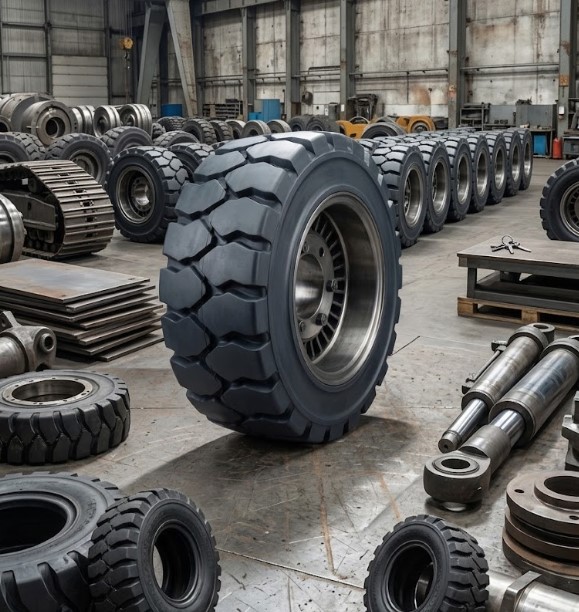
Forklift operations in modern warehouses, logistics hubs, and industrial plants require high-performance tires that can handle heavy loads, continuous use, and changing floor conditions. Polyurethane forklift tires are widely used due to their strong wear resistance, high load-bearing capacity, and long service life.
However, not all polyurethane (PU) tires perform the same. Their efficiency depends on selecting the correct grade based on hardness, composition, and application needs. Choosing the wrong grade can result in faster wear, overheating, reduced efficiency, and potential operational risks.
Understanding Polyurethane Forklift Tires
Polyurethane is an engineered elastomer that combines the flexibility of rubber with the strength of plastic. In forklift applications, it is commonly used in drive wheels, load wheels, and press-on tires due to its ability to:
 Handle heavy dynamic loads
- Resist abrasion and floor damage
- Reduce rolling resistance
- Provide long operational life in indoor environments
Industry studies show that PU forklift tires typically perform best in the Shore A 80A–95A hardness range, depending on the workload and floor condition .
The key to selecting the right tire is understanding that hardness is equal to performance trade-off, not just durability. Selecting the wrong grade can significantly reduce tire lifespan and performance. This is why many industries rely on experienced suppliers such as PU polyurethane suppliers in Dubai to ensure proper material selection for harsh operating conditions.
What Does “PU Grade” or Hardness Mean?
Polyurethane grade is measured using the Shore A scale, which determines how soft or hard the material is.
- Lower Shore A (70A–85A): Softer, more elastic
- Mid-range (85A–92A): Balanced performance
- High Shore A (92A–98A): Hard, rigid, high load capacity
Research shows that harder PU compounds reduce deformation under load, improving load capacity and stability, especially in high-density warehouse operations .
However, hardness alone does not determine quality, it must align with:
- Load per wheel
- Operating speed
- Floor surface type
- Temperature and chemical exposure
Common Polyurethane Grades for Forklift Tires
Here is a simplified breakdown:
80A–85A (Soft Grade)
- High elasticity
- Better shock absorption
- Suitable for light-duty operations
85A–92A (Medium Grade)
- Balanced wear resistance
- Ideal for most warehouse forklifts
- Best overall cost-performance ratio
92A–98A (Hard Grade)
- Maximum load capacity
- Minimal deformation
- Best for heavy-duty industrial forklifts
Most modern warehouse systems use 90A–95A as the industrial standard due to its balance of durability and performance.
Key Factors in Selecting the Right Polyurethane Grade
1. Load Capacity Requirements
The first and most important factor is how much weight each wheel supports.
- Heavy-duty forklifts → Higher hardness (92A–98A)
- Medium-duty pallet trucks → 88A–92A
- Light-duty warehouse carts → 80A–88A
If the polyurethane is too soft for a heavy load, it will deform, generate heat, and wear out quickly.
2. Floor Type and Surface Condition
Floor quality directly impacts tire performance.
- Smooth epoxy or polished concrete → Hard PU (92A–98A)
- Slightly rough industrial floors → Medium PU (85A–92A)
- Uneven surfaces → Softer PU for shock absorption
Harder polyurethane reduces rolling resistance on smooth floors, improving forklift efficiency and battery life in electric forklifts .
3. Operating Speed and Duty Cycle
High-speed and continuous operations generate heat inside the tire.
- Continuous shifts → Heat-resistant high-hardness PU
- Intermittent use → Standard mid-hardness PU
Excess heat is one of the main reasons for polyurethane failure, leading to cracking or delamination.
4. Environmental Conditions
Industrial environments in regions like the UAE and GCC often involve:
- High temperatures
- Oil and grease exposure
- Moisture or chemical cleaning
In such cases, PU must be specially formulated with additives for:
- Oil resistance
- Anti-hydrolysis protection
- Anti-static properties
5. Bonding Strength with Wheel Core
A major failure point in forklift tires is delamination (PU separating from metal core).
High-quality PU grades use advanced chemical bonding systems to ensure long-term adhesion between polyurethane and steel or aluminum hubs. This is especially critical in high-load forklifts and automated systems .
Industrial Applications of Polyurethane Components
Polyurethane is not limited to forklift tires. It is widely used across multiple industrial sectors. This helps buyers understand material consistency across applications.
For example, a dependable polyurethane manufacturer may also provide:
- PU rollers for conveyor systems used in warehouses and production lines
- Wear-resistant industrial components designed for high-friction environments
- Heavy-duty cushioning and damping elements used in machinery and equipment protection
Similarly, businesses looking for reliable sourcing often work with a trusted polyurethane products supplier UAE for custom-engineered PU solutions tailored to demanding applications.
Other related industrial PU applications include:
- PU crane buffer– shock absorption in heavy lifting systems
- PU mixer arm – abrasion-resistant mixing components
- PU screen mesh – wear-resistant screening in mining operations
- PU soft guard – protective safety components in machinery
All these applications share the same principle: choosing the correct PU grade ensures durability, safety, and performance stability.
Mistakes to Avoid When Selecting PU Forklift Tires
Many buyers make common mistakes:
1. Choosing hardness without considering load
This leads to early tire failure or overheating.
2. Ignoring floor conditions
Hard PU on rough floors increases vibration and equipment wear.
3. Using standard PU in chemical environments
This causes swelling, cracking, or material degradation.
4. Selecting low-quality bonding systems
This results in delamination and costly downtime.
Conclusion
Selecting the correct polyurethane forklift tire grade is not just a technical decision—it is a direct investment in operational efficiency, safety, and long-term cost control. From hardness levels (durometer) and load capacity to floor conditions, temperature, and run length, every factor plays a role in determining how well your tires perform in real-world warehouse and industrial environments.
The right choice ensures smoother operations, reduced downtime, better battery efficiency, and longer tire life, while the wrong selection can lead to faster wear, heat buildup, and unnecessary maintenance costs. By carefully matching tire grade to your actual working conditions, you can significantly improve both productivity and equipment reliability.
For businesses looking for durable, application-specific polyurethane solutions engineered for demanding industrial environments, Al Burhan Al Wadeh (ABAW) delivers high-performance PU components designed to meet real operational challenges with consistency and strength.
Contact polyurethane forklift tire experts today to select the right grade for your application and ensure long-lasting performance.
Explore More Expert Insights
Discover Product Guides from Trusted UAE Suppliers: Plan your next project with confidence.
- I Tested 5 Polyurethane Wheels Under Load: Here’s the Results: Real-world performance insights
- How to Choose the Right Rubber Sheet for Your Application: Expert tips for selecting durable and suitable rubber for your project.
- Types of Industrial Rubber Sheets and Applications: A complete guide to rubber sheet varieties and their real-world uses.
- Rubber vs Polyurethane Caster Wheels for UAE Floor Types: Choosing the right wheel material for durability, safety, and performance.