
 sales@abaw.ae

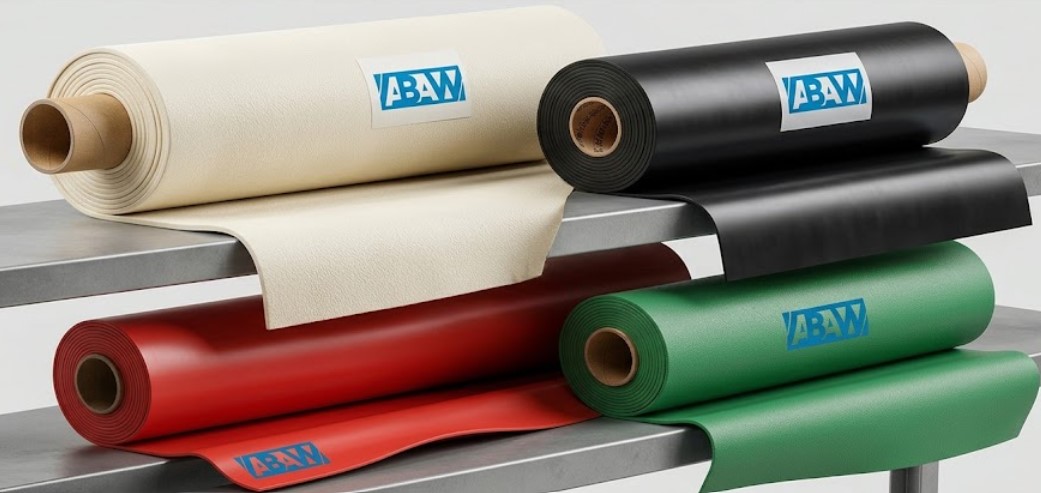
Rubber sits inside almost every industrial system, from pump seals and conveyor lines to flooring and gasket cutting. Yet buyers often mix up two terms: industrial rubber and rubber sheets. That confusion leads to wrong material orders, early failures, and avoidable downtime.
Knowing the real differences in industrial rubber vs rubber sheets helps procurement teams, maintenance engineers, and contractors specify the correct product the first time. It matters even more in the UAE, where heat, UV, humidity, dust, and oil exposure push elastomers harder than in most regions.
This guide explains what each term means, compares them side by side, and gives you a practical checklist for choosing between them.
What Is the Difference Between Industrial Rubber and Rubber Sheets?
Industrial rubber is the broad category of engineered elastomer materials and products built for demanding mechanical, thermal, and chemical conditions. Rubber sheets are one flat, rolled form of that category, supplied in set thicknesses and widths for cutting, lining, gasketing, and flooring. Every rubber sheet is industrial rubber, but not all industrial rubber is a sheet.
Think of it as a family and one of its members. Industrial rubber also includes hoses, seals, O-rings, gaskets, rollers, bushings, anti-vibration mounts, and molded components. A rubber sheet is the flat stock that fabricators cut, punch, or bond into many of those parts.
That distinction sits at the heart of industrial rubber vs rubber sheets. One term describes a material family and its finished products. The other describes a specific format of supply.
What Is Industrial Rubber?
Industrial rubber is vulcanized natural or synthetic elastomer engineered for heavy-duty mechanical, thermal, and chemical service. Compounders add fillers, curing agents, and stabilizers to tune hardness, tensile strength, and resistance to heat, oil, ozone, and abrasion, so the finished material performs predictably under load. That predictability separates industrial rubber from general-purpose rubber.
The polymer you choose defines how the material behaves. The most common options include:
 Natural rubber (NR): high elasticity and tear strength, but weak against oil and ozone.
- SBR: economical, abrasion-resistant, suited to general-purpose work.
- Neoprene (CR): balanced weather, flame, and moderate oil resistance.
- Nitrile (NBR): strong resistance to oils and fuels.
- EPDM: excellent heat, steam, ozone, and UV resistance, but poor with mineral oils.
- Silicone (VMQ) and FKM (Viton): wide temperature range and high chemical resistance, at a higher cost.
Engineers often reference the ASTM D2000 classification system, which grades compounds by heat aging and oil swelling resistance. It gives buyers a shared language for calling out a rubber material on a purchase order.
What Are Rubber Sheets?
Rubber sheets are flat, vulcanized elastomer panels or rolls produced in standard thicknesses, widths, and hardness grades, usually measured in Shore A.
Fabricators cut them into gaskets, pads, liners, and washers, while contractors lay them as heavy-duty anti-slip flooring, matting, or protective layers. Their flat format makes them one of the most versatile forms of industrial rubber.
Thicknesses range from thin sheets used for gaskets to thick panels used for heavy-duty lining, though available sizes vary by polymer and supplier. Most sheets ship as rolls or cut panels, which keeps storage and fabrication simple.
Popular rubber sheet types include:
- SBR sheet: general-purpose and cost-effective.
- Neoprene sheet: weather and flame resistance.
- Nitrile sheet: oil and fuel resistance.
- EPDM sheet: outdoor, steam, and hot-water service.
- Silicone sheet: wide temperature range, with food and medical grades.
- Insertion (cloth-reinforced) sheet: higher tensile strength for flange gaskets and pressure sealing.
Industrial Rubber vs Rubber Sheets: How Do They Compare?
Industrial rubber is a broad category of engineered elastomer products, including seals, hoses, molded parts, and flat stock. Rubber sheets are one specific form of industrial rubber, supplied in flat rolls or panels.
Key differences include:
- Definition: Industrial rubber covers a wide range of engineered rubber materials and products, while rubber sheets are flat, rolled, or panel-form rubber products.
- Typical Forms: Industrial rubber includes seals, hoses, O-rings, bushings, and molded or extruded parts. Rubber sheets are supplied as rolls or cut panels in different thicknesses.
- Customization: Industrial rubber components may require molds, dies, or specialized tooling. Rubber sheets can be cut, punched, or bonded in workshops or on-site.
- Best Applications: Industrial rubber is suitable for precision components and high-volume manufacturing. Rubber sheets are commonly used for gaskets, linings, pads, flooring, and protective covers.
- Setup Cost: Custom industrial rubber components may involve higher upfront tooling costs. Rubber sheets generally require less initial investment and simpler fabrication.
- Dimensional Tolerance: Molded industrial rubber components can achieve tighter dimensional tolerances. Rubber sheet tolerances depend on material specifications and cutting methods.
- Lead Time: Custom molded rubber parts may take longer due to tooling and production requirements. Standard rubber sheets are often available from stock.
Important: A gasket cut from a rubber sheet is still an industrial rubber product. The main difference lies in how the rubber component is manufactured, supplied, and used.
What Should You Check Before Buying Industrial Rubber or Rubber Sheets?
Check hardness, tensile strength, temperature range, chemical resistance, and compression set before you buy any industrial rubber product or rubber sheet. These five properties decide whether the material survives your real operating conditions day after day, including heat, oil exposure, abrasion, UV, and outdoor weathering.
- Hardness (Shore A): roughly 40 to 50 for soft sealing, 60 to 70 for general duty, 80 and above for load-bearing or wear applications.
- Tensile strength and elongation: how far the rubber stretches and recovers without tearing.
- Temperature range: continuous and peak limits of the polymer.
- Chemical resistance: compatibility with oils, fuels, acids, solvents, and cleaning agents.
- Compression set: how well the material recovers after being squeezed, which is critical for gaskets.
Always request a technical datasheet. Properties can vary between suppliers, even when the polymer name is identical.
What Is the 5-Point Rubber Selection Checklist?
The 5-point checklist is a practical framework that helps buyers match the right rubber compound and format to the job. It covers operating environment, mechanical load, form factor, compliance needs, and total lifecycle cost, and you should score every point before approving a purchase order.
- Environment: temperature, oil, fuel, chemicals, UV, ozone, and humidity.
- Mechanical load: compression, abrasion, impact, and dynamic flexing.
- Form factor: a finished part such as a seal or hose, or flat stock for cutting and lining.
- Compliance: fire retardancy, food contact, potable water, or electrical insulation certificates where required.
- Lifecycle cost: price per year of service, not price per kilogram.
Need help comparing grades? Explore the full range of industrial rubber and rubber sheets from a trusted rubber supplier in UAE before you finalize your specification.
Where Are Industrial Rubber and Rubber Sheets Used?
Industrial rubber is used wherever machinery, pipelines, and vehicles need reliable sealing, damping, or abrasion protection across industrial plants.
Rubber sheets are used for gaskets, equipment lining, heavy-duty anti-slip flooring, machine vibration pads, and conveyor skirting in factories, workshops, and warehouses.
Typical industrial rubber applications include:
- Hydraulic and pneumatic seals
- Pump diaphragms and expansion joints
- Conveyor belts and rollers
- Hoses and bushings
- Anti-vibration mounts
Typical rubber sheet applications include:
- Flange and cover gaskets
- Chute, hopper, and tank linings
- Workshop and gym matting
- Pads under compressors and generators
- Electrical insulation mats, where properly rated
Why Does UAE Climate Change Rubber Selection?
Heat, UV radiation, ozone, humidity, and fine dust accelerate rubber aging across the UAE, especially on outdoor installations and coastal sites. Untreated natural rubber hardens and cracks faster under these conditions, while EPDM and neoprene resist weathering far better in outdoor service.
That is why polymer selection matters more than price. A low-cost natural rubber sheet that cracks within a season costs more than a correctly graded EPDM or neoprene sheet. A knowledgeable provider of industrial rubber supply in UAE can match the compound to your site conditions.
How Do You Choose Between a Rubber Sheet and a Molded Rubber Part?
Choose a rubber sheet when you need flat surface coverage, custom-cut shapes, or low-volume gasket and pad cutting directly on site. Choose a molded or extruded industrial rubber part when you need a precise profile, repeat dimensions, tight tolerances, or high-volume production.
Use these simple decision rules:
- Need an exact profile at volume: choose molded or extruded rubber.
- Need varied, one-off gaskets: choose a rubber sheet.
- Need to cover a large surface: choose a rubber sheet.
- Need dynamic sealing on shafts or pistons: choose a molded seal.
What Are the Most Common Buying Mistakes?
The most common mistakes are choosing by hardness alone, ignoring oil or heat exposure, picking the wrong thickness, and skipping compression set checks for gaskets. Each error shortens service life and often appears only after installation, when replacement means costly unplanned downtime.
- Using a natural rubber sheet where oil contact causes swelling.
- Selecting a thin sheet for an abrasion liner that wears through early.
- Ignoring thermal cycling, which causes gasket leaks.
- Skipping fire or food-contact certificates and failing an inspection.
Request the datasheet and confirm the polymer before every order.
Industrial Rubber vs Rubber Sheets: Which Should You Choose?
Choose industrial rubber products when you need finished, precision components, and choose rubber sheets when you need flexible flat stock for cutting, lining, or covering. Neither is better in every case, because the right answer depends on polymer, environment, load, and order volume.
For most plants, workshops, and contractors, the practical path is to use both: sheets for flexible, on-site fabrication and molded rubber for critical, repeat components. Whichever you pick, verify the compound against the datasheet and your operating conditions before ordering.
Industrial rubber vs rubber sheets is not a contest. It is a specification decision, and a clear specification saves money. If you source regularly, working with a supplier that stocks multiple polymers and thicknesses, including rubber sheets, shortens lead times and reduces specification risk.
Ready to specify the right rubber? Al Burhan Al Wadeh supports buyers in Sharjah, Dubai, and across the UAE with industrial rubber and rubber sheets matched to real operating conditions.
Contact our rubber supply team with your application, size, and quantity, and we will help you select the right grade and thickness.
FAQs
What is the main difference between industrial rubber and rubber sheets?
Industrial rubber is the broad category of engineered rubber materials and products, including seals, hoses, and molded parts. Rubber sheets are one flat format within that category. Choose sheets for cutting and lining jobs, and choose molded industrial rubber for precision components.
Which rubber sheet is best for oil and fuel resistance?
Nitrile (NBR) rubber sheets offer the strongest oil and fuel resistance among common general-purpose options. For very high temperatures or aggressive chemicals, FKM (Viton) performs better but costs more. EPDM is a poor choice for mineral oils.
Can rubber sheets be used outdoors in hot climates?
Yes, but only with the right compound. EPDM and neoprene sheets resist UV, ozone, and weathering far better than untreated natural rubber. In hot climates, confirm the temperature rating on the datasheet and choose a stabilized, weather-resistant grade.