
 sales@abaw.ae

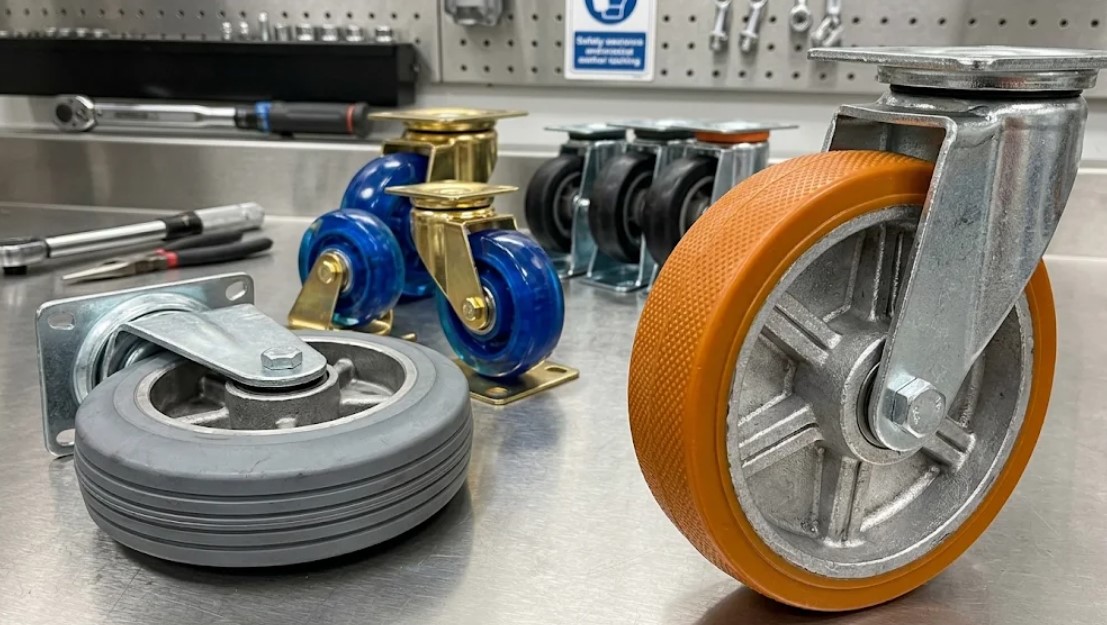
Caster wheel testing decides whether a trolley, rack, or cart lasts five years or fails in five months. As warehousing, logistics, and manufacturing expand across the Emirates, equipment moves more weight, more often, over harder floors. A printed load rating alone is no longer enough to buy with confidence.
This guide explains how durability and performance tests work, which standards apply, and how to read a test report before you place an order.
What Is Caster Wheel Testing and Why Does It Matter?
Caster wheel testing is a set of controlled laboratory and field procedures that measure how a wheel and its mounting bracket handle load, impact, rolling effort, and wear. It predicts real-world lifespan before failure happens, protecting equipment, cargo, and operators from costly downtime.
A caster is more than a wheel. It is a system of tread, core, bearings, axle, fork, swivel head, and sometimes a brake. A weakness in any one part can cause failure, so testing evaluates the full assembly.
Testing also exposes the gap between a catalogue rating and actual behaviour. Operators learn about floor damage, noise, push effort, and replacement cycles before committing to a bulk purchase.
Which Standards Govern Caster Wheel Testing?
Caster wheel testing standards include EN 12530 and EN 12532 for manually moved equipment, ANSI/BIFMA X5.1 for office seating components, and ASTM methods for materials such as hardness and corrosion. Each defines test loads, cycle counts, and pass criteria, so buyers can compare products objectively.
Recognised standards bodies such as ISO publish internationally accepted requirements that give every manufacturer the same yardstick. Without one, two casters rated at 200 kg can behave very differently.
Always confirm which standard a supplier actually tested against. Also check whether the report covers your exact product or only a similar model.
What Core Tests Measure Caster Wheel Durability?
Five core procedures form the backbone of most caster wheel durability testing programmes. Each one targets a different failure risk.
How Is Caster Wheel Load Capacity Tested?
Load capacity testing applies a static load, usually well above the rated figure, to confirm the wheel and bracket do not deform or crack. A dynamic load test then rolls the loaded caster over set distances to confirm the rated capacity holds under real movement.
After testing, the bracket, axle, and wheel core are inspected for permanent deformation. A caster that bends under proof load fails, regardless of its catalogue rating. Heavy duty caster wheels are typically tested at higher proof loads than light-duty types.
How Is Impact and Shock Resistance Tested?
Impact testing drops a loaded caster from a defined height or rolls it over a fixed obstacle to simulate dock edges, floor joints, and kerbs. Inspectors then check for cracked treads, bent forks, loosened axles, and bearing damage that would signal early failure.
This result matters most where trolleys cross dock plates, lift thresholds, or uneven concrete. Shock loads can reach several times the static weight. A caster that passes a basic load test may still fail in service.
How Is Caster Wheel Endurance and Fatigue Tested?
Endurance testing runs a loaded caster continuously over a drum, treadmill, or track for thousands of metres or cycles. Engineers inspect the wheel for tread wear, flat spots, bearing play, and bracket cracks at set intervals to estimate service life.
Endurance data supports service-life estimates, but results depend on test speed, surface, and load. Treat them as comparison tools rather than guarantees.
How Is Rolling Resistance and Swivel Performance Measured?
Rolling resistance testing measures the force needed to start and keep a loaded caster moving, often called push-pull force. Swivel testing checks how smoothly the caster rotates and how well the swivel lead and bearings resist play, noise, and wobble.
Low rolling resistance reduces operator strain and motor load on powered carts. Smooth swivel action matters when trolleys turn in narrow aisles.
How Are Caster Brakes Tested?
Brake testing locks the wheel or swivel under load on an inclined or flat surface and applies a set force to confirm the caster holds position. Reliable brakes matter on ramps, loading docks, and hospital or trolley applications where unintended movement creates safety risk.
Wheel brakes, total-lock brakes, and directional locks each need separate checks.
How Do Wheel Materials Change Caster Wheel Testing Results?
Wheel material changes test results because hardness, elasticity, and chemical resistance differ across polyurethane, nylon, rubber, and cast iron. Polyurethane caster wheels protect floors and absorb shock, while nylon and cast iron handle higher loads with less rolling effort but may produce more noise.
Tread hardness is commonly expressed on the Shore A scale and measured using ASTM D2240 methods. Softer treads provide better cushioning and quieter movement, while harder treads generally roll more easily under heavy loads.
Polyurethane:
Offers floor protection, abrasion resistance, and quiet rolling. Testing focuses on hardness, wear resistance, and load deformation. Commonly used in warehouses, trolleys, and equipment carts.
Nylon:
Provides high load capacity, chemical resistance, and low rolling resistance. Testing focuses on impact resistance and brittleness. Suitable for industrial carts and wet or chemical environments.
Rubber:
Provides shock absorption, better grip, and noise reduction. Testing focuses on compression set and tread wear. Commonly used for indoor carts and uneven floors.
Cast Iron:
Handles very heavy loads and high temperatures. Testing focuses on static load capacity and potential floor damage. Suitable for heavy machinery and hot industrial environments.
Compare options before you order. Matching a wheel to its test data saves money over the equipment's life. Explore tested heavy duty and industrial ranges from a caster wheels supplier UAE businesses can rely on, and compare load ratings side by side.
How Do UAE Heat and Humidity Affect Caster Wheel Testing?
UAE heat and humidity accelerate tread softening, lubricant breakdown, and metal corrosion, so standard room-temperature results can overstate real lifespan. Buyers in coastal and industrial zones should ask for thermal ageing and salt spray results alongside load and impact data.
Four environmental factors deserve attention:
 Thermal ageing: high temperatures soften some polymers and reduce load capacity.
- Salt spray: coastal air corrodes unprotected brackets, tested under ASTM B117.
- Dust and sand ingress: fine particles wear bearings that lack proper seals.
- Chemical exposure: cleaning agents and oils can swell or crack certain treads.
A caster that performs well in a European test lab may behave differently on a hot loading apron. Environment-specific data closes that gap.
How Can Buyers Evaluate Caster Wheel Test Reports?
Buyers can evaluate caster wheel test reports by checking the referenced standard, test load, cycle count, surface conditions, and pass criteria.
A credible report identifies the test method, provides measured results, and confirms whether the sample was a production unit rather than a hand-built prototype.
Use this 5-Point Caster Test Scorecard to assess test report reliability. Score each parameter from 0 (missing) to 2 (fully documented).
- Standard Referenced: Check which testing method and standard edition were used. A report without a named standard is a red flag.
- Test Load: Verify static and dynamic test loads against the caster's rated capacity. A single load figure without supporting details is insufficient.
- Cycles or Distance: Check the total endurance cycles or distance covered during testing. Vague claims such as "long life" lack measurable evidence.
- Testing Environment: Review temperature, floor surface, and corrosion testing conditions. Testing only on a smooth laboratory floor may not reflect actual operating conditions.
- Sample Type: Confirm whether testing was performed on a production unit. Prototype or unidentified samples may not represent the quality of commercially supplied caster wheels.
What Are Common Caster Wheel Failure Modes?
Common caster wheel failures include tread delamination, flat spotting, bearing seizure, fork fatigue cracks, and axle bolt loosening. Most trace back to overloading, mismatched material selection, debris such as thread or banding wire, or chemical exposure rather than random manufacturing defects.
Each failure maps to a test that should have caught it:
- Tread delamination: found through endurance and heat testing.
- Flat spotting: found through long static load and compression checks.
- Bearing seizure: found through swivel, dust, and rolling resistance tests.
- Fork cracks: found through impact and fatigue testing.
- Loose axles: found through dynamic load and vibration checks.
Spotting these patterns early lets maintenance teams replace parts on schedule instead of after a breakdown.
Is Caster Wheel Testing Worth Prioritising When Buying?
Caster wheel testing is worth prioritising for any equipment that carries heavy loads, moves daily, or operates in harsh conditions. For light, occasional use in controlled indoor spaces, a standard rated caster from a reliable supplier is generally enough for the job.
The practical rule is simple. The heavier the load, the harsher the floor, and the longer the duty cycle, the more test evidence you should demand. Working with an experienced partner such as Al Burhan Al Wadeh helps buyers match tested specifications to real operating conditions.
Need help specifying the right caster? Send us your load, floor type, and operating environment and request a caster wheel quotation. Our team supports businesses across Sharjah, Dubai, and the UAE.
FAQs
What is the difference between static and dynamic load capacity on caster wheels?
Static load capacity is the maximum weight a caster supports while stationary, and dynamic load capacity is the maximum weight it carries while rolling. Dynamic ratings are lower because movement adds shock, friction, and fatigue, so buyers should size casters against the dynamic figure.
Which caster wheel material lasts longest on concrete floors?
Polyurethane on a cast iron or nylon core typically gives the best balance of wear life and load capacity on concrete. It resists abrasion better than standard rubber and rolls easier, though the right choice still depends on load, temperature, and chemical exposure.
Can I request test data from a caster wheel supplier before buying?
Yes, you can request test data, and a credible supplier should share it for bulk or industrial orders. Ask for the standard referenced, rated static and dynamic loads, material specifications, and any salt spray or thermal results relevant to your operating environment.